
Technology’s expansion of cartography is constantly redefining how we make sense of the world, our societies, and most importantly our ever expanding cities. Of growing interest in the map world are Isochronic Maps, or maps which distort geographic data in order to fix it to boundaries representing uniform travel times. You may have seen these types of maps in projects by Oskar Karlin or the web app Mapnificent. Whereas these maps are used to assist commuters in making more informed transit decisions, there is another powerful feature of Isochronic Maps; historical comparison.
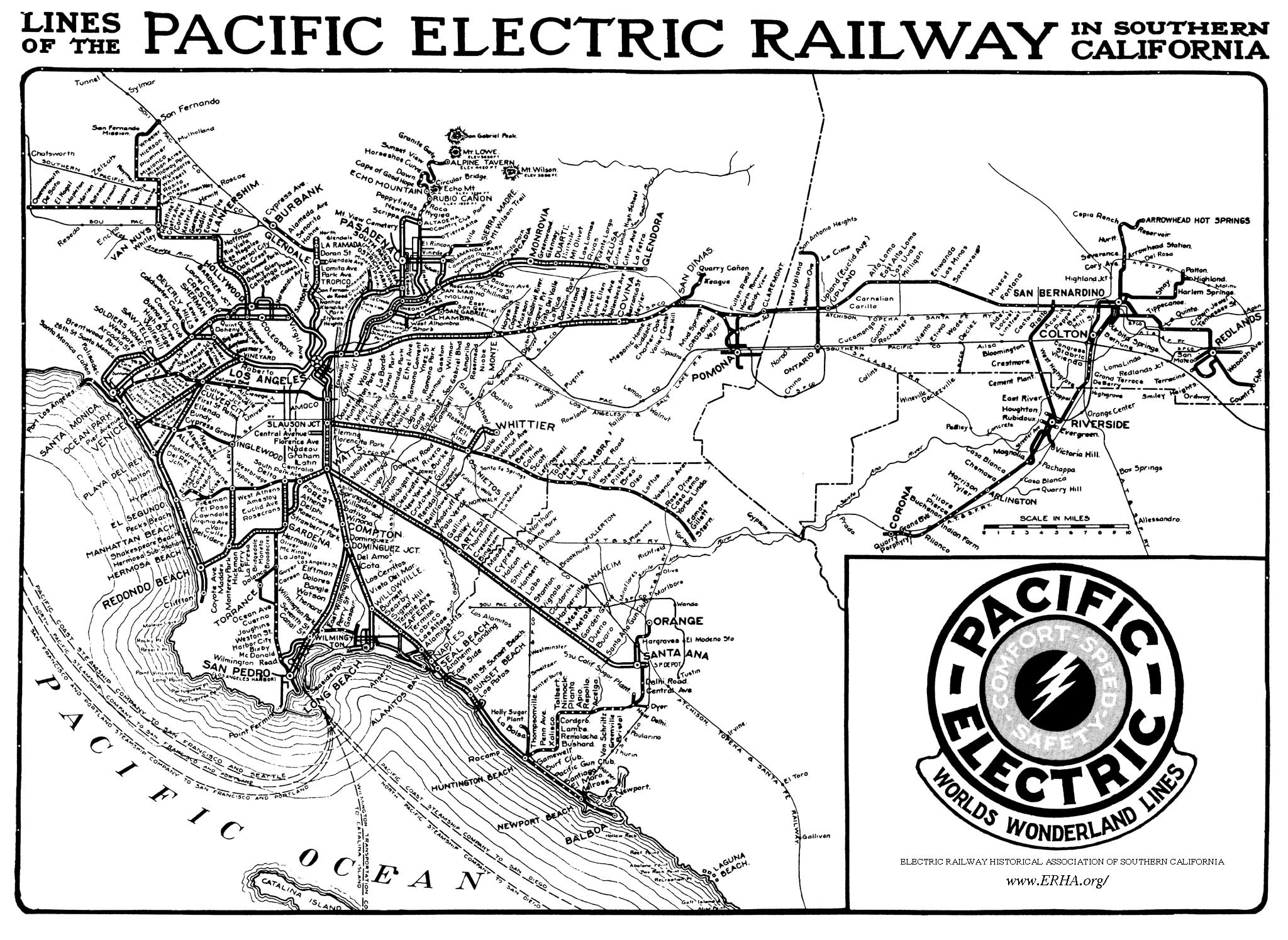
Historic Map of the Pacific Electric Red Car Lines
Radical Craft’s Isochronic Mountain project is an in depth study of the evolution of Sao Paulo’s public transportation infrastructure from 1939 to present day. In particular it studies the Isochronic Maps created to document the now defunct Bondes Linhas (tram lines). During their operation, Bondes offered efficient transportation from the edge of a 9km radius to the center of Sao Paulo. The details of these maps drove designers at Radical Craft to dare to be a bit radical, and use the maps’ Isochronic Lines as contour lines for a temporal topography model. The result is a tectonic analog chronicling challenges posed by terrain, waterways, and urban parcels.
According to Radical Craft Founder, Joshua G. Stein
“These two mountains of time allow residents to understand the uphill climb necessary to move from the periphery to the city center. Viewed comparatively, they demonstrate how this struggle has intensified over the last 70 years due to the erosion of transit infrastructure in relationship to the growing urban megalopolis.”
Against the backdrop of the massive public protests that swept across Brazil in June and
July of 2013, the Isochronic Mountain Project takes on a new life as visual representation of the disparity that exists in Sao Paulo, the origin of the transit protests. After 70 years of deterioration, literally erosion, the final grievance was a bus fare hike from R$3 to R$3.20.